I have been testing an inkjet image of this drawing which was printed on copy paper the same day I made prints using all the different papers. The test is simply spraying a small section of the print with water, and seeing what happens. The first test was the day the print was made, and there was lots of ink running and discoloration, but as time passed, the water was having less of an effect on the print. This backs up the theory that leaving inkjet prints to sure for a few days is necessary.
Today I saw very little movement of the ink on the copy paper, so I decided to revisit the original prints to see how they would hold up to the transparency process. I used the concertina sketchbook I made yesterday as the base for my findings, and I’ll be transferring all the notes I took during today’s session to the back of each page.
I started with the eight samples, each of which had two prints of the portrait. I decided to only use one of each, in case there was a chance a longer curing time might yield better results.
Results were mixed, which is not a surprise, although some results were a surprise. Some papers were obviously not going to work, but I wanted to do the process to keep a record anyway.
After I had gone through all eight, I remembered the original paper that led to this obsession, the couch roll that is not at all the same paper as the medical exam paper available in the US. I had one print of this portrait on that paper that had cured for a day longer than the ones I had started working with. Might as well give it a second chance.
If you are following along, you may remember that when I tried it as a transparency the ink ran and discoloured. Well, today it did not do either of those things. The couch roll is 2-ply, and I didn’t separate the plies, and it did not go fully transparent, but one of the earlier experiments did show that it will go transparent if I only use one ply.
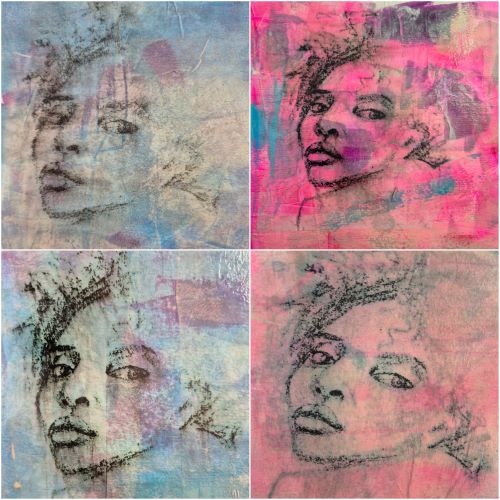
In the end I narrowed my papers down to four that I want to experiment further with, and I have three different ways of making the image transfer, so I’m going to carry on testing to see if I can come up with a go-to process for making transparencies using my own drawings.
Some of the other papers were rejected because the original print smeared, or they smeared too much during the transparency process, or they simply didn’t go transparent. A couple of the papers didn’t go transparent, but did give very crisp prints of the image, so they may have potential for other things.
The four successes are in the image above, and they are Tissutex, two different weights of tissue paper, and the couch roll that I initially thought was a write-off.
More to do, but so much fun.
Til the morn,
Suzanne
455/500
 Thrummie Bizzum
Leave a comment