I was thinking I had probably exhausted the options for this deep-dive, other than honing my skills with the application process, and I was thinking I was satisfied with my discoveries.
Then I had an idea.
I wasn’t even thinking about art, or this process, or anything at all to do with art, I was somewhere else entirely, and it occurred to me that fixative might be a game changer. A tiny, random, floating thought in the dark of night landed.
I had planned for other things in the studio today, but they can wait. Today I got going with printing and spraying and note-making and doing happy dances, and reader, it’s a wonderful day.
I decided to test workable fixative, because my logic decided that since any transparencies I make would likely be applied to mixed media layers, that would be the best option. I plan on testing the standard fixatives tomorrow, so there’s more to come 😉
I tested out three different papers – the Tissutex, the stronger of the two tissue papers, and the couch roll that set this whole adventure in motion.
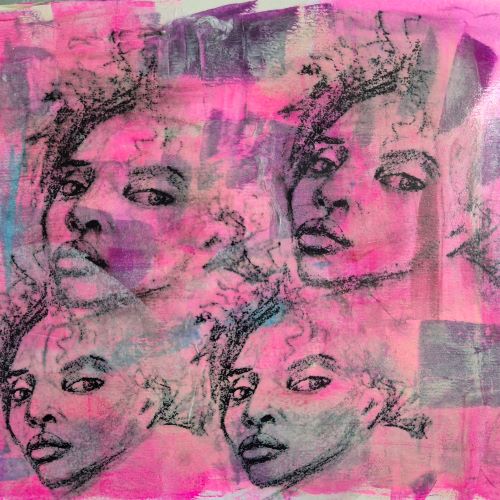
Each one gave slightly different results, but all were successful. The image above is the page in my concertina sketchbook with the tests of the tissue paper (I’m calling it ’tissue 2′ because it’s the more recent purchase).
Top left is the first test piece I did, where the inkjet print cured for seven days before subjecting it to the transparency process. I suppose this becomes the control image.
Top right is an inkjet print I made today with Spectrafix workable fixative. It’s transparent, slightly sharper, and although there was an ink run, it hasn’t impacted the quality of the image.
Both lower images were made using the Krylon workable fixative, but I got a bit ahead of myself with the one on the left and forgot to spray with water and some contact with the gloss gel medium was made, so I did a second application just to be sure.
The Krylon workable fixative seems to fix the image more sharply, particularly in the little details on the hair, but the transparency isn’t quite as good.
With the couch roll, I got more transparency with the Krylon, but really both samples were leaning towards translucent. Using the couch roll single-ply is better, which is probably not a surprise.
The Tissutex transparencies were more successful with the fixative, and I think the Krylon wins by a hair’s breadth for sharpness and transparency.
Overall I think it’s a toss-up between the tissue paper and Spectrafix, or the Tissutex and Krylon, so the deciding factor would be ‘do I want to go outside to spray this with stinky Krylon, or do I want to stay inside and use the non-toxic Spectrafix?’
I have options 🙂
Tomorrow I’ll test the permanent fixatives to see what they do, but my jury is in – it is entirely possible to make successful image transfers from my own drawings using an inkjet printer and a gel plate, or to make transparencies without the luxury of a very specific medical exam paper that isn’t, to my knowledge, made/sold in the UK.
I’ll take this as a win.
Til the morn,
Suzanne
457/500
 Thrummie Bizzum
Leave a comment